1. What is auditing?
Imagine an association has a treasurer who manages all the money throughout the year. The board and members trust the treasurer – but they cannot check every single receipt and payment at the annual meeting. That is why an auditor is needed: someone whose job it is to go through the accounts and answer the question:
"Does what the accounts show match reality – and do the figures give a fair picture of the association's finances?"
The auditor is not the association's adversary. On the contrary – a good audit strengthens trust and gives the board, treasurer, and all members confidence that the finances are properly managed.
2. Lay auditor – what is that?
Large companies and listed corporations are legally required to engage a chartered auditor – a trained professional. Smaller associations (non-profit organisations, student nations, housing cooperatives) rarely have that obligation. Instead, they elect a lay auditor at their general meeting.
A lay auditor does not need to be a trained accountant. However, it is important to understand that the assignment is still a serious one: the lay auditor has a legal and moral responsibility to review the accounts in a thorough and independent manner.
| Lay auditor (small association) | Chartered auditor (large company) |
|---|---|
| Elected by the association's members | Engaged as a professional, regulated by law |
| No formal qualifications required | Chartered after several years of training |
| Usually works alone | Works in a team with specialists |
| Reviews on a "reasonableness" basis | Follows ISA (international auditing standards) |
| Writes a simpler audit report | Standardised audit report |
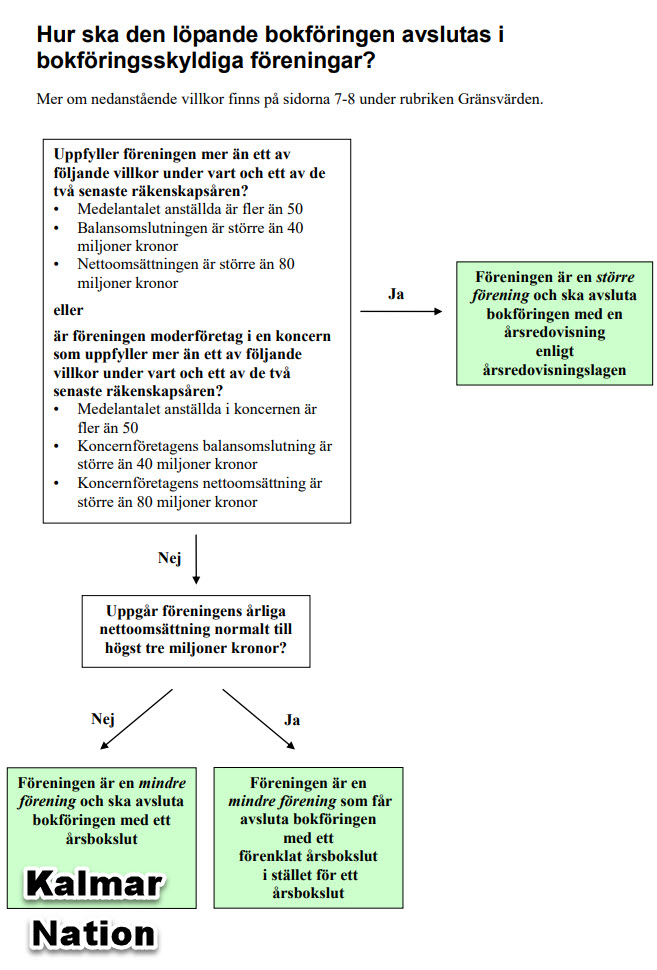
Which type of year-end closing is an association required to prepare? BFN's decision tree (below, p. 4) distinguishes three levels based on annual revenue. Kalmar Nation's net revenue is approximately 4 million SEK – which exceeds the threshold of 3 million SEK. Kalmar Nation is therefore required to prepare a K2-based annual accounts statement (BFNAR 2017:3), not a simplified K1 statement. The association does not qualify as a "larger association" and is not required to prepare a full annual report. For a more detailed explanation of the three levels, see: Simplified Annual Accounts, Annual Accounts or Annual Report. Note: the diagram is in Swedish.
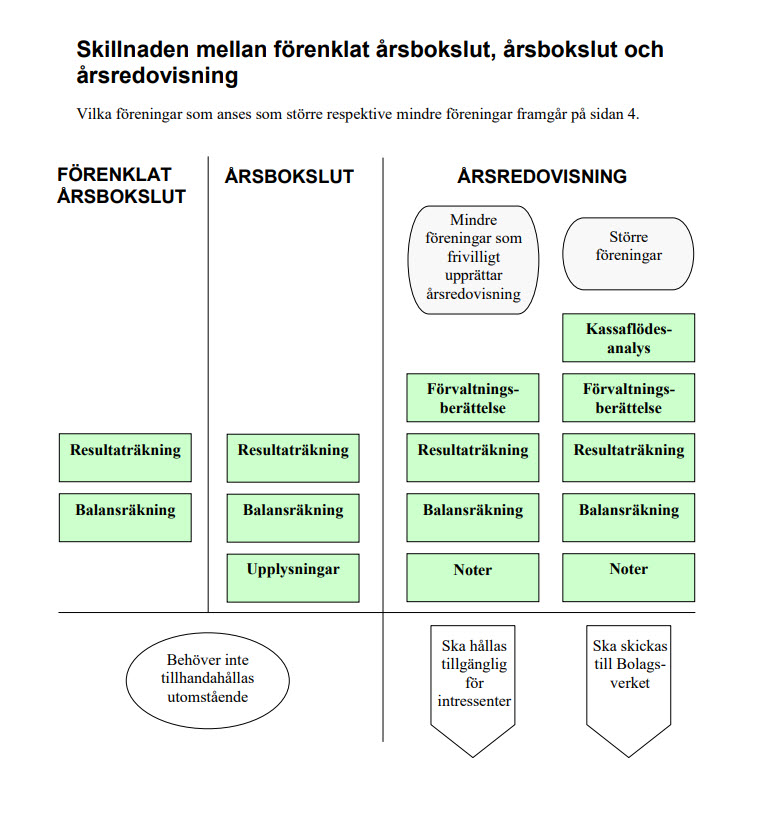
The diagram below (p. 5) shows what documents and components are required at the K1, K2 and annual report levels:
3. What is reviewed – 10 steps?
Here are the 10 steps that make up a thorough review of a small association:
-
Prerequisites and risk assessment
The very first step is to read and analyse the association's statutes – before a single figure is reviewed. The statutes govern the entire audit mandate and can have decisive consequences for how the audit is structured:- Do the statutes require a qualified auditor? Some associations' statutes state that the auditor must be a professionally authorised or approved accountant. If so, a lay auditor is not qualified to carry out the review – a fundamental issue that must be resolved before work can begin.
- What deadlines apply? The statutes normally specify when the audit report must be completed and when accounts and supporting documents must be submitted to the auditor. A delay against the statutory deadlines is in itself a matter for comment in the audit report.
- What must actually be reviewed? In addition to the accounts, the statutes may require the auditor to examine stipend funds, donated assets or specific operations. These are separate audit areas not automatically covered by a standard review of the income statement and balance sheet.
-
Bank reconciliation
The bank's own account statement is compared with what the accounts show for the bank balance. They must match exactly. If they do not – why not? -
Result = Change in equity
If the association made a surplus of SEK 100,000, the association's equity must have increased by exactly SEK 100,000. If this does not hold, it is a warning sign of accounting errors or incorrect entries. -
Continuity check (CB = OB next year)
What the accounts show the association owned on 31 December must be exactly the same as the starting point on 1 January the following year. Otherwise, figures may have been changed without a traceable record. -
Sample check on vouchers Voucher list
The auditor randomly selects a number of accounting entries and checks that the receipt or invoice matches what has been recorded.
The starting point is the voucher list – a report exported directly from the accounting system (Visma eEkonomi) listing every entry made during the year: voucher number, series (A, B, K, M, Z...), date, amount and account. This is not a physical binder – it is a digital report the financial officer exports in a few minutes (Reports → General Journal → Export as Excel).
Different series = different types of document. Series A is typically supplier invoices (e.g. drink deliveries), series K customer invoices, series M manual corrections and series Z cash register (Zettle). The auditor focuses the sample on the series carrying the greatest financial risk. -
Comparative analysis (year on year) – and budget review
Revenue and costs are compared with the previous year. Did something increase dramatically – and if so, why? Systematic deficits year after year may indicate structural problems.
If a budget was approved for the year under review, actual versus budget is compared: were significant variances anticipated or unexpected? An unexplained variance requires a comment from the board.
If the association has approved a budget for the coming financial year (e.g. 2026), a thorough audit includes reviewing it and assessing whether it is realistic in light of the current year's results and the association's circumstances. An unrealistic budget risks providing misleading guidance to the board. -
Receivables – old unpaid customer invoices Voucher list
A receivable arises when the association has sent a customer invoice (typically series K in the accounting system) but has not yet been paid. The invoice appears as an asset in the balance sheet – but if the money never comes in, it is in reality a loss. The auditor requests the accounts receivable ledger and checks how old the outstanding items are: invoices older than 6 months should be discussed with the financial officer and possibly written off.▶ Method: matching K-series against I-series to identify older receivables
Common mistake: It is not sufficient to confirm that all current-year K-invoices have been paid. Account 1510 (accounts receivable) also contains receivables from prior years – represented by the account's opening balance (OB). If the auditor only matches the current year's K-invoices against the current year's I-payments, the conclusion may incorrectly be "no old unpaid receivables".
The matching key is the invoice number. The I-series description field contains the invoice number in parentheses, e.g. "Payment Moll Wendén (730)". Link each I-entry to its K-invoice via this number. K-invoices without a matching I-entry are unpaid.
Identify payments of prior-year invoices: I-entries with an invoice number lower than the current year's first K-invoice are payments of receivables from prior years (or older). Subtract these from OB of account 1510 to calculate what remains from previous years.
Control formula:
CB acc. 1510 = (OB − payments of prior-year invoices) + unpaid current-year invoices
If the calculated closing balance matches the balance sheet figure with a difference of SEK 0.00, the matching is complete.Remaining prior-year receivables (OB minus prior-year payments received) are by definition at least 12 months old at the balance sheet date and represent the real risk item. Ask the financial officer: what do these relate to? Are payments expected, or should they be written off?
-
Fraud check (using common sense) Voucher list
Are there transactions without supporting documentation? Duplicate payments? Unusual withdrawals? The auditor scans the full voucher list for warning signs: round amounts without an invoice, gaps in numbering sequences (missing vouchers), payments to unusual recipients. The auditor keeps their eyes open – not to suspect everyone, but to protect the association and its elected representatives. -
Management review – the board's conduct
The audit does not only examine the figures – it also assesses whether the board has carried out its mandate in accordance with the association's statutes and the decisions made by the general meeting. The primary sources are the annual activity report (verksamhetsberättelse) and the minutes of board meetings.
The auditor checks: Have significant financial decisions (purchases, loans, grants) been made by the board and recorded in the minutes? Does the activity report's description of the year align with the actual financial events? Has the board acted transparently towards the association's members?
The management review concludes with the auditor's recommendation on whether the board should be granted discharge from liability (ansvarsfrihet) at the general meeting. It is therefore an equally important part of the lay audit as the financial review. -
Audit report
The review concludes with an audit report – the formal document signed by the auditor and presented at the association's general meeting. The report covers two parts: financial review (do the figures give a true and fair view of the association's finances?) and management review (has the board acted in accordance with the statutes and decisions of the general meeting?). The auditor recommends whether the board should be granted discharge from liability.
4. Key terms – explained in plain language
5. What should the auditor pay particular attention to in a small association?
A small association often does not have a team of financial professionals – the person responsible for finances may change every year, and procedures may be lacking. The auditor should ask themselves:
- Has the financial officer changed since the last audit? (Risk: knowledge and context may have been lost in the handover.)
- Did the finances change significantly compared with last year? (Requires an explanation.)
- Does a single person handle the entire financial flow? (Increased risk of errors.)
- Is the accounting system consistent and well-structured?
- Are there old receivables that are unlikely ever to be paid?
The technical instruction that governs how the AI assistant acts as auditor is found in CLAUDE.md. That file is written for the AI model (more technical and detailed) and is not primarily intended as accessible reading for non-accountants.
Scan to open or share this page

kentlundgren.github.io/foreningar/KalmarNation/revision/generellt_eng.html